

Comparative adjectives are an important part of English grammar for Grade 6 students. They help learners describe differences between people, animals, objects, places, and situations. Understanding how to form and use comparative adjectives also helps students improve their writing, speaking, and performance in English tests.
To master this grammar point, students need to distinguish between short and long adjectives, remember spelling rules, and recognize irregular comparative forms. This article provides Grade 6 Comparative Adjectives Exercises, covering grammar explanations, multiple-choice questions, sentence transformations, and error correction activities, with answers and explanations to support independent learning.
Comparative Adjectives Rules for Grade 6
Before attempting the exercises, students should review the basic structures and spelling rules for comparative adjectives. A solid understanding of these rules makes it easier to choose the correct form and avoid common mistakes.
Comparative Adjectives Exercises: Short Adjectives
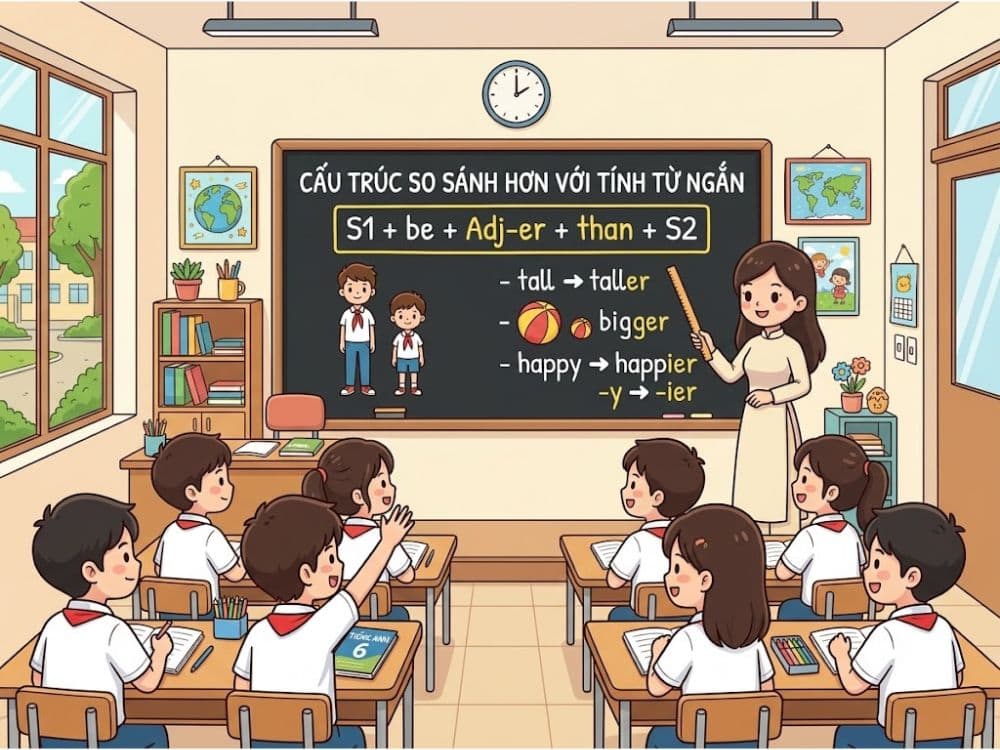
Short adjectives usually have one syllable. Some two-syllable adjectives, such as happy, narrow, simple, and clever, can also take the ending -er.
Structure:
Subject + be + adjective-er + than + noun/pronoun.
Examples:
- My brother is taller than me.
- This bag is cheaper than that bag.
- The weather today is colder than yesterday.
Spelling Rules for Short Comparative Adjectives
Students should pay attention to the final letters of an adjective when adding -er.
| Rule | Example |
| Add -er to most short adjectives | tall → taller |
| Add -r to adjectives ending in -e | large → larger |
| Double the final consonant in consonant-vowel-consonant words | big → bigger |
| Change consonant + y to -ier | happy → happier |
Remember that not every two-syllable adjective takes -er. Students should learn common exceptions and check unfamiliar words when necessary.
Comparative Adjectives Exercises: Long Adjectives
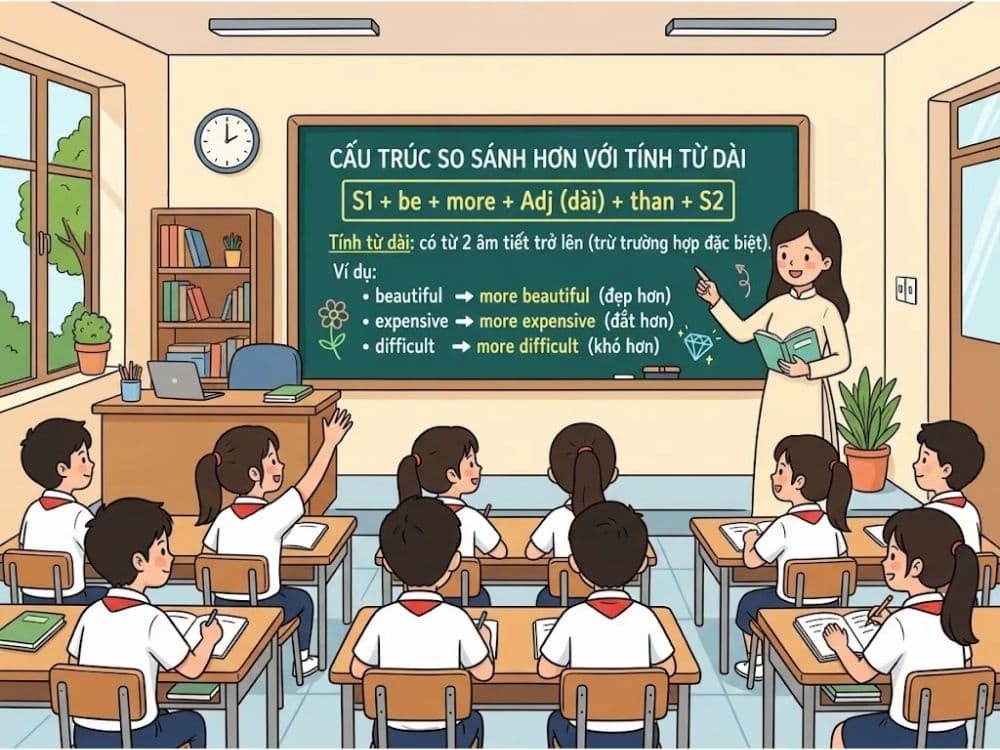
Most adjectives with two or more syllables form the comparative using more + adjective.
Structure:
Subject + be + more + adjective + than + noun/pronoun.
Examples:
- English is more interesting than I expected.
- This exercise is more difficult than the previous one.
- A train journey is more comfortable than a long bus journey.
Common mistake: Do not use more and -er together with the same adjective. Write taller, not more taller, and easier, not more easier.
Irregular Comparative Adjectives for Grade 6
Some adjectives and adverbs have irregular comparative forms. They do not follow the usual rules for adding -er or using more.
| Base form | Comparative form | Meaning |
| good / well | better | of higher quality |
| bad / badly | worse | of lower quality |
| far | farther / further | at a greater distance |
| little | less | a smaller amount |
| much / many | more | a greater amount or number |
Examples:
- My English is better than last year.
- This result is worse than the previous one.
- She has less free time than her sister.
How to Recognize Comparative Adjectives in Sentences
The word than often signals a comparison between two people, objects, or situations. However, students should read the entire sentence rather than rely on one word alone.
Examples:
- A bicycle is slower than a motorbike.
- My new school is bigger than my old school.
- This film is more exciting than that one.
To answer comparative adjective questions accurately, identify the two things being compared, find the adjective, and choose the correct comparative structure.
Grade 6 Comparative Adjectives Exercises with Answers
The following Grade 6 Comparative Adjectives Exercises cover several question types, from basic adjective forms to sentence transformations and error correction. Complete each activity before checking the answer key.
Exercise 1: Complete the Sentences with Comparative Adjectives
Write the correct comparative form of the adjective in brackets.
- My house is (big) __________ than yours.
- This room is (comfortable) __________ than that one.
- Health is (important) __________ than money.
- Gold is (heavy) __________ than silver.
- A sports car is (fast) __________ than a normal car.
- She is (helpful) __________ than her brother.
- My result in Math is (bad) __________ than my result in English.
- Winter is (cold) __________ than summer.
- This street is (narrow) __________ than that street.
- Watching TV is (interesting) __________ than reading books.
- Traveling by train is (safe) __________ than traveling by motorbike.
- A dog is (intelligent) __________ than a cat.
Exercise 2: Comparative Adjectives Multiple-Choice Questions
Choose the best answer to complete each sentence.
- Ha Long City is __________ than it was many years ago.
A. modern
B. more modern
C. modernest
D. most modern - Traveling by plane is __________ than traveling by bus.
A. quick
B. quicker
C. more quick
D. quicken - This test is __________ than the previous test.
A. difficulter
B. difficultest
C. more difficult
D. difficulty - Living in a city is often __________ than living in the countryside.
A. noisier
B. noisy
C. noisiest
D. more noisier - An elephant is __________ than a tiger.
A. large
B. larger
C. more large
D. largest - My sister draws __________ than I do.
A. good
B. well
C. better
D. best - This book is __________ than the one I read last week.
A. interestinger
B. more interesting
C. most interesting
D. as interesting - The weather today is __________ than yesterday.
A. hoter
B. hotter
C. more hot
D. hottest
Exercise 3: Comparative Adjectives Sentence Transformation Exercises
Rewrite each sentence without changing its original meaning.
- A chair is cheaper than a sofa.
→ A sofa is __________________________________. - Her old house is smaller than her new house.
→ Her new house is ___________________________. - Nga is shorter than Lan.
→ Lan is _____________________________________. - No one in my class is smarter than Nam.
→ Nam is ____________________________________. - This ruler is longer than that pencil.
→ That pencil is ______________________________. - A motorbike is slower than a car.
→ A car is ___________________________________.
Exercise 4: Find and Correct the Mistakes
Each sentence contains one mistake related to comparative adjectives. Identify and correct it.
- My room is more bigger than yours.
- This exercise is difficulter than the last one.
- Lan is more tall than Hoa.
- Today is hoter than yesterday.
- His health is gooder than before.
Answer Key for Grade 6 Comparative Adjectives Exercises
After completing the activities, check your answers and review the explanations for any questions you answered incorrectly.
Answers to Exercise 1
- bigger
- more comfortable
- more important
- heavier
- faster
- more helpful
- worse
- colder
- narrower
- more interesting
- safer
- more intelligent
Explanations for common mistakes:
- Question 1: Big follows the consonant-vowel-consonant spelling pattern, so the final g is doubled before adding -er.
- Questions 2 and 3: Comfortable and important generally use more in the comparative form.
- Question 4: Heavy changes y to i before adding -er, becoming heavier.
- Question 7: Bad is irregular, and its comparative form is worse.
- Question 9: Narrow can form its comparative as narrower.
Answers to Exercise 2
| Question | Answer | Explanation |
| 1 | B. more modern | Use more with modern. |
| 2 | B. quicker | Quick is a one-syllable adjective. |
| 3 | C. more difficult | Difficult generally uses more. |
| 4 | A. noisier | Noisy changes y to i before -er. |
| 5 | B. larger | Large takes -r. |
| 6 | C. better | Better is the comparative of well. |
| 7 | B. more interesting | Interesting is a long adjective. |
| 8 | B. hotter | Hot doubles its final consonant. |
Answers to Exercise 3
- A sofa is more expensive than a chair.
- Her new house is bigger than her old house.
- Lan is taller than Nga.
- Nam is smarter than anyone else in my class.
- That pencil is shorter than this ruler.
- A car is faster than a motorbike.
Sentence transformation tip: Identify which object has the greater degree of the quality being compared. Then reverse the subjects and adjust the adjective accordingly. With sentences containing no one, check the wording carefully to preserve the original meaning.
Answers to Exercise 4
- more bigger → bigger
- difficulter → more difficult
- more tall → taller
- hoter → hotter
- gooder → better
These mistakes often occur when students apply two comparative rules simultaneously or forget irregular forms. Keep a record of incorrect answers and review similar examples to reinforce learning.
Tips for Mastering Comparative Adjectives in Grade 6
Regular practice can help students use comparative adjectives more accurately in both written exercises and everyday communication.
Classify adjectives before answering. Decide whether an adjective generally takes -er or uses more + adjective. This helps prevent errors such as more taller and difficulter.
Memorize irregular forms. Words such as good, bad, and far have special comparative forms. Learn them through examples and regular use instead of memorizing isolated word lists.
Read the instructions carefully. Gap-fill questions, multiple-choice activities, and sentence transformations require different approaches. For sentence transformations, check that the rewritten sentence retains the original meaning.
Review mistakes after every practice session. Do more than check whether an answer is right or wrong. Identify the reason for each mistake and try similar questions again. This approach helps reinforce grammatical knowledge.
Mastering comparative adjectives gives Grade 6 students a stronger foundation for English grammar, sentence writing, and communication. Combine grammar revision with regular practice to improve accuracy and confidence in school tests and everyday conversations.
Frequently Asked Questions About Grade 6 Comparative Adjectives Exercises
How can students distinguish between short and long adjectives?
One-syllable adjectives generally take -er, while most adjectives with two or more syllables use more. However, some two-syllable adjectives, such as happy and narrow, can take -er.
When should students use than in comparative sentences?
Use than after a comparative adjective or adverb when introducing the person or thing being compared. For example: My bag is heavier than yours.
How do adjectives ending in -y change in the comparative form?
For adjectives ending in a consonant followed by y, change y to i and add -er. For example, happy becomes happier and heavy becomes heavier.
Can students use more and -er together?
No. Do not use more and -er with the same adjective. Write taller instead of more taller and easier instead of more easier.
Which comparative adjective exercises should Grade 6 students practice first?
Start with adjective-form exercises, move on to multiple-choice questions, and then practice sentence transformations and error correction. This sequence builds understanding from basic rules to practical application.
Related keywords:
- Comparative adjectives exercises with answers
- Grade 6 English grammar exercises
- Comparative adjectives worksheet for Grade 6
- Comparative adjectives sentence transformation exercises
- Comparative adjectives rules for Grade 6