

In the journey to build a strong English language foundation for young children, selecting an appropriate international certification serves as an encouraging starting point. The Cambridge English: Pre A1 Starters examination offers a gentle introduction to foreign language learning for candidates aged 5 to 8, helping primary school students adapt to standardized test formats without experiencing academic strain.
However, parents and educators guiding young learners through initial preparation often face questions regarding module structures, selecting a reliable Cambridge Starters 1 book, and establishing effective home study routines. This article provides a comprehensive overview of the assessment, breaks down requirements across listening, reading, writing, and speaking modules, and outlines structured study strategies to help young candidates achieve strong shield results on test day.
Overview of the Assessment in a Cambridge Starters Prep Guide
To guide young learners effectively, understanding the core characteristics and qualification framework of this entry-level examination is an essential starting point.
What Is the Pre A1 Starters Qualification?
The Pre A1 Starters assessment represents the introductory level within the Young Learners English (YLE) qualification suite organized by Cambridge Assessment English. Designed specifically for primary school children, the test introduces foundational English concepts through colorful illustrations, interactive tasks, and relatable everyday communication scenarios.
At this level, testing focuses on evaluating basic word recognition, comprehension of simple sentence patterns, and elementary conversational responses regarding familiar topics such as family, colors, animals, toys, food, school items, and daily activities.
Qualification Level and Shield-Based Scoring
Under the Common European Framework of Reference for Languages (CEFR), the qualification aligns with the Pre A1 level—serving as an introductory benchmark for beginner language learners. Completing this level builds a foundation before students transition to higher qualifications, such as A1 Movers and A2 Flyers.
An encouraging aspect of the Cambridge YLE evaluation system is the absence of pass or fail designations. Learner performance is recognized through colorful shield icons, with a total maximum score of 15 shields distributed evenly across three skill modules:
- Listening Module: Up to 5 shields.
- Reading and Writing Module: Up to 5 shields.
- Speaking Module: Up to 5 shields.
Scoring through shields reduces test anxiety, encourages continued study habits, and gives children a tangible sense of personal achievement. Earning 10 to 12 shields overall indicates strong preparation, confirming that a candidate is ready to progress toward A1 Movers materials.
Educational Value for Primary School Learners
Participating in structured study routines for this assessment yields several practical benefits for young candidates:
- Developing Natural Speech Reflexes: Children practice listening to native-speaker audio prompts and responding with short clauses in appropriate context.
- Familiarization with Standardized Testing: Learners gain confidence completing individual task sheets and participating in 1-on-1 speaking interactions with assessors.
- Identifying Skill Strengths: Structured evaluations help parents and language teachers detect specific vocabulary gaps or skill areas needing reinforcement.
- Building Long-Term Study Momentum: Receiving official certification credentials decorated with achievement shields fosters genuine interest in language learning.
Module Breakdown in a Cambridge Starters Prep Guide
A complete test paper in a Cambridge Starters prep guide comprises three skill components requiring approximately 45 minutes of total testing time, evaluating comprehensive communication abilities.
Listening Component Techniques
The listening module lasts approximately 20 minutes and includes 20 questions divided across 4 distinct parts. Tasks combine native-speaker audio tracks with clear visual illustrations:
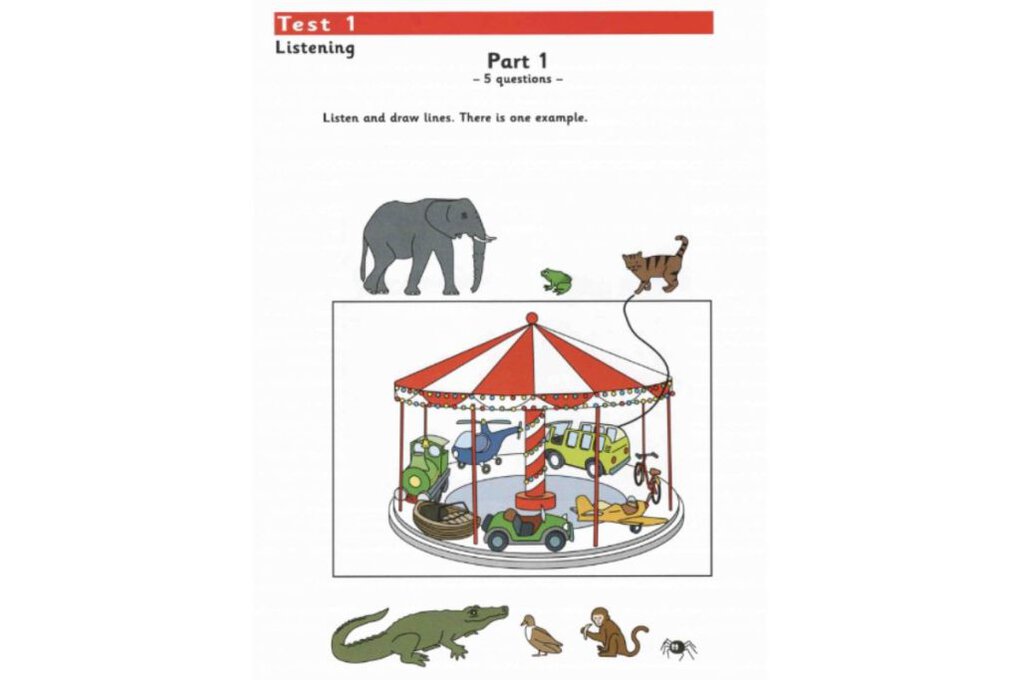
- Part 1 (Name and Picture Matching): Candidates observe a large illustration depicting multiple figures engaged in everyday activities. Candidates listen to a dialogue and draw connecting lines from given character names to matching figures in the scene.
- Part 2 (Note Taking and Information Recording): Candidates listen to a short conversation between an adult and a child, recording specific proper names or numbers on a answer sheet.
- Part 3 (Multiple Choice Selection): Candidates listen to 5 independent short dialogues. Each prompt is accompanied by a question and 3 picture choices (A, B, or C), requiring candidates to mark the correct visual option.
- Part 4 (Coloring and Following Instructions): Candidates examine a line drawing containing similar objects, listening to spoken instructions to color designated items accurately.
Effective Listening Strategies: Teach young learners to focus on key information words rather than struggling to translate every individual word. Encouraging candidates to examine visual illustrations before audio playback begins helps them anticipate conversation context.
Reading and Writing Module Overview
The reading and writing module spans 20 minutes and contains 25 questions distributed across 5 parts, testing word recognition and basic sentence comprehension:
- Part 1 (Vocabulary and Image Verification): Candidates look at pictures paired with descriptive sentences, placing a tick mark if the description is correct or a cross mark if incorrect.
- Part 2 (Picture Narrative Evaluation): Candidates examine a detailed scene illustration and read short statements, writing “yes” if statements accurately describe the picture or “no” if statements are inaccurate.
- Part 3 (Letter Unscrambling): Candidates look at object images accompanied by jumbled letter sets, arranging letters into correctly spelled vocabulary words.
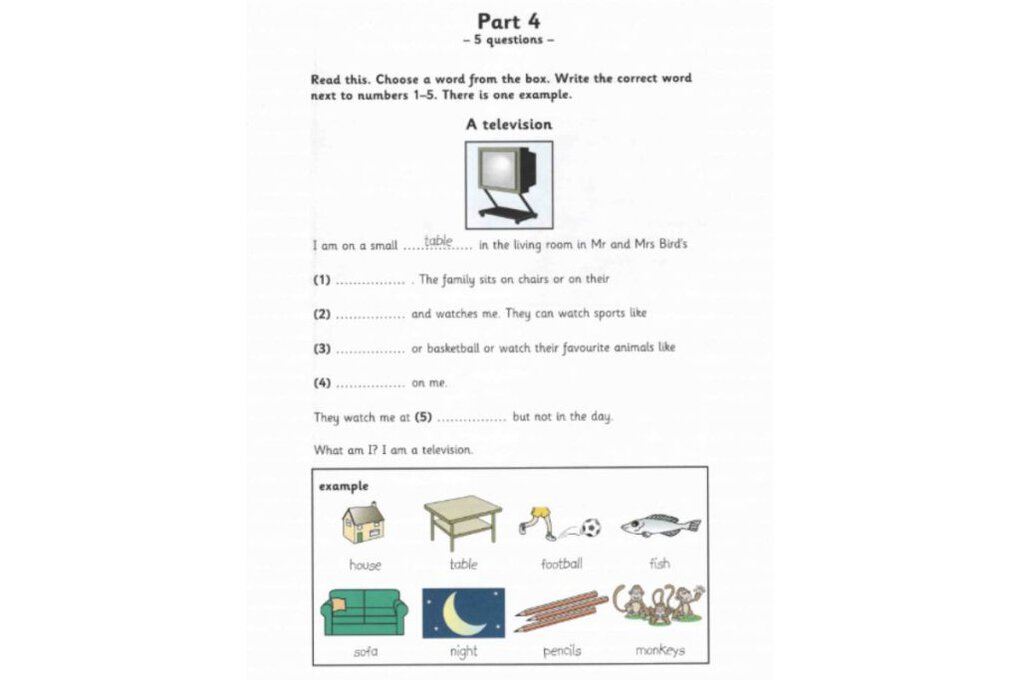
- Part 4 (Guided Text Completion): Candidates read a short descriptive passage containing missing spaces, selecting matching illustrated word cards to fill missing spaces.
- Part 5 (Image Sequence Story Questions): Candidates observe a 3-frame picture narrative, reading short prompt questions and writing single-word or numerical answers.
Accuracy Guidelines for Reading and Writing: Instruct candidates to maintain legible handwriting and double-check letter-by-letter spelling accuracy when copying vocabulary words onto task sheets.
Speaking Skill Module Development
The speaking component takes 3 to 5 minutes during a face-to-face interaction with an assessor, supported by visual cue cards and starters speaking test pictures:
- Part 1 (Identifying Objects in Scene Cards): The assessor greets the candidate and prompts them to point out specific items within a large scene card (e.g., “Where is the dog?”).
- Part 2 (Placing Object Cards on Scene Pictures): The assessor provides small object cards (starters speaking test pictures) and instructs the candidate to position them on specified locations within the main scene illustration (e.g., “Put the banana next to the monkey”).
- Part 3 (Responding to Scene Prompts): The assessor points to scene details, asking short questions regarding colors, quantities, or character actions (e.g., “What is this?”, “What color is it?”, “How many apples are there?”).
- Part 4 (Describing Small Object Cards): The assessor indicates individual object cards, asking about item functions or personal preferences related to the objects.
- Part 5 (Personal Questions): The assessor asks direct personal questions regarding the candidate’s age, family, school routines, or favorite leisure activities.
Speaking Exam Preparation: Assessors maintain a supportive atmosphere during testing. Practice sessions should focus on building cheerful conversational reflexes, polite greetings, and clear spoken responses.
Utilizing Practice Tests and Materials in a Cambridge Starters Prep Guide
Practicing with standardized mock test collections enables candidates to consolidate vocabulary, build testing reflexes, and measure performance progress over time.
Structuring Practice Test Papers
A comprehensive collection of Cambridge Starters practice tests should follow a progressive difficulty structure to support student learning:
- Initial Familiarization Tests: Focus on basic task formats and primary vocabulary topics such as colors, numbers, animals, and family members, helping candidates learn page navigation and coloring instructions.
- Skill Development Tests: Expand vocabulary coverage to include school subjects, sports, food items, and weather conditions, introducing tasks that require precise letter spelling and counting skills.
- Comprehensive Mock Tests: Replicate official exam specifications in timing, task distribution, and question complexity, providing realistic evaluation prior to test day.
Effective Home Practice Routines
To maximize learning outcomes without overwhelming young children, parents should apply structured study habits:
- Managing Study Sessions: Avoid requiring children to complete full practice test sets in a single sitting. Divide practice sessions by individual skills (Listening, Reading, Writing, or Speaking).
- Introducing Timed Practice: Once task rules are understood, enforce official time limits during practice sessions so candidates adapt to exam pacing naturally.
- Analyzing Missed Questions: Following each practice paper, review incorrect answers together with the candidate to determine whether errors stemmed from unfamiliar vocabulary, hasty reading, or listening distractions.
Step-by-Step Study Roadmap for Beginners
A structured study schedule divided into distinct learning phases ensures young learners absorb language concepts comfortably while maintaining interest in English.
Phase 1 Vocabulary Building and Listening Exposure
During the initial 2 to 3 months, focus primary efforts on acquiring foundational vocabulary terms across core YLE topics:
- Teach vocabulary utilizing visual flashcards, educational songs, and interactive learning games.
- Introduce daily starters test listening practice using short dialogues to familiarize young ears with native speech cadence.
- Encourage children to label household items using basic English words.
Phase 2 Four-Skill Integration with Coursebooks
As candidates establish core word recall, transition into structured coursebook materials such as a Cambridge Starters 1 book or equivalent skill-building series:
- Develop reading comprehension through short descriptive sentences and image matching exercises.
- Practice letter spelling accuracy using word-unscrambling tasks and fill-in-the-blank activities.
- Conduct interactive speaking drills using conversational prompt cards.
Phase 3 Mock Exam Practice and Final Preparation
During the final 1 to 2 months prior to official testing, focus on test simulation routines using a Cambridge Starters prep guide:
- Administer complete Cambridge Starters practice tests under formal testing conditions.
- Conduct mock speaking evaluations utilizing official starters speaking test pictures to simulate examiner interactions.
- Review official Cambridge vocabulary lists to ensure no essential topic terminology has been overlooked.
Common Preparation Mistakes to Avoid
Avoiding common instructional oversights ensures study time remains effective and positive for young candidates:
- Introducing Full Practice Tests Too Early: Attempting full exam papers before candidates build sufficient vocabulary causes frustration and reduces learning motivation.
- Overemphasizing Complex Grammar Rules: The assessment measures practical word recognition and contextual understanding. Rote memorization of formal grammar rules is unnecessary at this entry level.
- Neglecting Interactive Speaking Practice: Focusing exclusively on paper-based reading and writing tasks ignores the speaking module, which accounts for one-third of overall achievement shields.
- Skipping Error Analysis: Recording score totals without reviewing specific mistake causes prevents candidates from correcting recurring spelling or listening errors.
Building Learner Confidence for Test Day
Guiding a young child through their first international language assessment requires patient instruction and positive reinforcement. Understanding module requirements, utilizing quality coursebooks, and following a structured study roadmap enables parents to support candidate progress effectively. The value of early language certification lies in cultivating careful work habits, building natural communication reflexes, and fostering genuine academic confidence. With thorough preparation and encouraging guidance, young candidates can approach their assessment calmly and achieve their target shield achievements on test day.
Frequently Asked Questions About a Cambridge Starters Prep Guide
What is the recommended age to begin a Pre A1 Starters certificate program?
The ideal age range is between 5 and 8 years old (primary school grades kindergarten through second grade). At this stage, children possess basic literacy awareness and absorb foreign language concepts quickly through natural communication.
How long does a complete Pre A1 Starters examination take?
The total assessment time across all three modules is approximately 45 minutes (excluding short breaks between components):
- Listening Module: approximately 20 minutes.
- Reading and Writing Module: 20 minutes.
- Speaking Module: 3 to 5 minutes.
How many shields represent a strong result on a Pre A1 Starters certificate?
The evaluation system does not use pass or fail grades, offering a maximum of 15 shields across all three modules. Earning 10 to 12 shields or higher (with no individual module falling below 2 shields) represents a strong result, indicating readiness for A1 Movers level preparation.
Can parents prepare children at home without attending language centers?
Parents can guide children effectively at home using structured study sets and a Cambridge Starters prep guide. However, attending structured classes provides peer interaction opportunities and conversational practice with language instructors.
Keywords:
- Pre A1 Starters certificate
- Cambridge Starters practice tests
- Cambridge Starters 1 book
- Starters test listening practice
- Starters speaking test pictures